
Every once in a while, a field report arrives that reminds us exactly why preservation matters.
Recently, Ryan Bird sent an outstanding update on Rueger, a Full Blood Elkhound male from the Revna × ARCO litter born nearly two years ago at Christmas time.
Ryan works as an outfitter in the Golden, British Columbia region, spending countless days in remote mountain country where encounters with wildlife are simply part of everyday life. In that environment, a dependable working dog is not a luxury. It is a necessity.
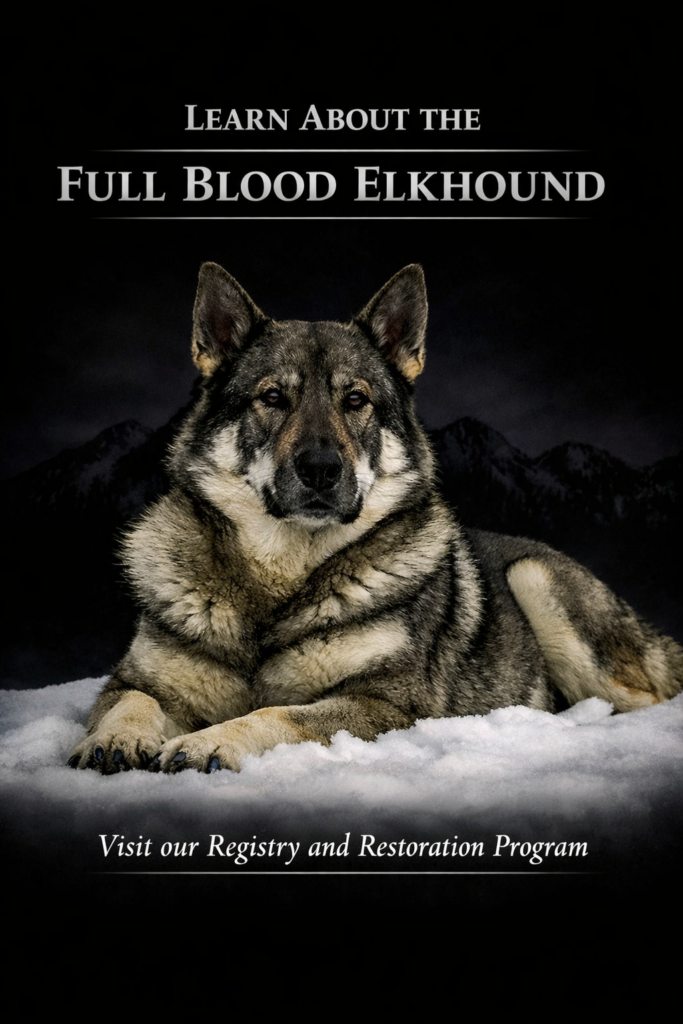
Rueger has grown into exactly the kind of dog we hoped he would become.
For Ryan, Rueger serves as both camp guardian and working partner, helping keep camps secure and alerting on bears while Ryan scouts, guides, and travels through some of British Columbia’s most rugged terrain. These are not occasional wildlife encounters. Ryan regularly works in bear country where both black bears and grizzlies are common.
This is where the Full Blood Elkhound heritage shines.

Long before modern dog shows and companion breeding programs, the northern hunting spitz breeds earned their reputation as large-game dogs. The original bear dogs of the North were expected to possess intelligence, courage, endurance, and enough judgment to manage dangerous wildlife while working alongside their handlers. Those instincts cannot simply be recreated overnight. They are preserved through generations of careful selection and stewardship.
The Revna × ARCO breeding was one of the most important preservation combinations in the program. Revna brings together the ancient Norrland bloodlines through her mother Luna while also carrying the renowned Finnish-Norwegian bear-dog heritage through her sire Karu. ARCO contributes powerful Finnish Jamthund genetics through his mother, the registered Finnish Jamthund Varella, a lineage known for its bear-dog heritage. Through his sire line, ARCO also traces through Ark to the exceptional Finnish foundation dogs Aina and Rico, both respected for their bear-dog instincts, working ability, and influence within the preservation architecture.
The result was a litter that combined multiple northern hunting traditions and generations of proven bear-dog ancestry into a single preservation pairing.
Nearly two years later, Rueger is demonstrating exactly the traits those bloodlines were valued for.
According to Ryan, Rueger consistently moves black bears and grizzlies well away from camp. Rather than simply causing a temporary disturbance, Rueger takes the bears a considerable distance from camp so that they are less likely to return and create problems around camp operations.
One recent video shared by Ryan perfectly illustrates the kind of work Rueger is performing. The footage shows Rueger engaging a large black bear and pushing it up a tree, creating a safe route for Ryan to travel through while working in remote terrain. It is practical working-dog performance in exactly the environment these northern bear dogs were originally developed to handle.
The experience has impressed Ryan enough that he would like to add a second Elkhound to his operation, preferably another dog carrying the Revna bloodline. In the country he works, he believes a pair of Elkhounds would be highly beneficial and provide even greater capability in the field.
For us, reports like these are invaluable.
Pedigrees, registration records, and lineage documentation all serve an important purpose, but ultimately the true test of any preservation program is whether the dogs can still perform meaningful work when placed in demanding real-world situations. Rueger is demonstrating that the instincts, awareness, confidence, endurance, and bear-dog characteristics remain very much alive within these bloodlines.
When we talk about preservation, this is exactly what we mean. The value of a bloodline is not measured only by papers or records, but by the ability of descendants to step into demanding environments and successfully perform the work their ancestors were known for. In the mountains around Golden, British Columbia, Rueger is proving every day that those instincts remain intact.
We are currently planning another litter from Revna and have not yet finalized our decision on a sire. Revna continues to impress us in every way and remains one of the most important females in the program. Reports like Ryan’s only reinforce the value of the genetics she contributes.
Hopefully Ryan will be able to travel down our way later this November. If schedules line up, it will be wonderful to see both Ryan and Rueger again and hear even more stories from the field.
A sincere thank you goes out to Ryan for sharing the photos, videos, and updates, and for giving Rueger such a meaningful life. There is no better evaluation of a working dog than seeing him succeed day after day in the environment he was bred for.
Rueger stands today as another reminder that the Full Blood Elkhound remains far more than a pedigree. He is a working northern bear dog carrying generations of Norrland, Finnish-Norwegian, and Finnish Jamthund bear-dog heritage into the wilderness of British Columbia, doing exactly the kind of work these dogs were created to do.