
For more than a century, the men who lived and worked with the original Scandinavian Elkhounds wrote with remarkable clarity. Their descriptions were not vague, poetic, or open to interpretation. They were precise, functional, and rooted in the realities of northern work.
They described males that were:
- robust
- powerful
- deep‑chested
- heavily muscled
- endurance‑built
- dark, rugged, and substantial
These were not “medium‑small, quick little dogs.” They were serious northern working males, built to travel all day in deep snow, navigate terrain, and stand up to moose, bear, and weather.
Yet modern “Elkhound aficionados” — especially those tied to the show-ring interpretation — routinely take those original descriptions and rewrite the meaning. They add commentary that the old writers never intended, twisting functional language into cosmetic justification.
The pattern is always the same:
Original historical statement: “The dogs must be robust and powerful, able to work all day.”
Modern reinterpretation: “This doesn’t mean big. It means small, compact, quick.”
This is not interpretation. This is revisionism.
It is an attempt to retrofit the modern, downsized, ring‑bred dog into a historical context where it simply does not belong.

The Historical Males Were Big, Dark, and Powerful
Take any photograph from 1890–1910 of the northern Elkhound males. You see:
- 60–70 lb males
- deep rib cages
- heavy bone
- thick necks
- broad heads
- dark coats
- substantial frames
- the unmistakable presence of a working northern dog
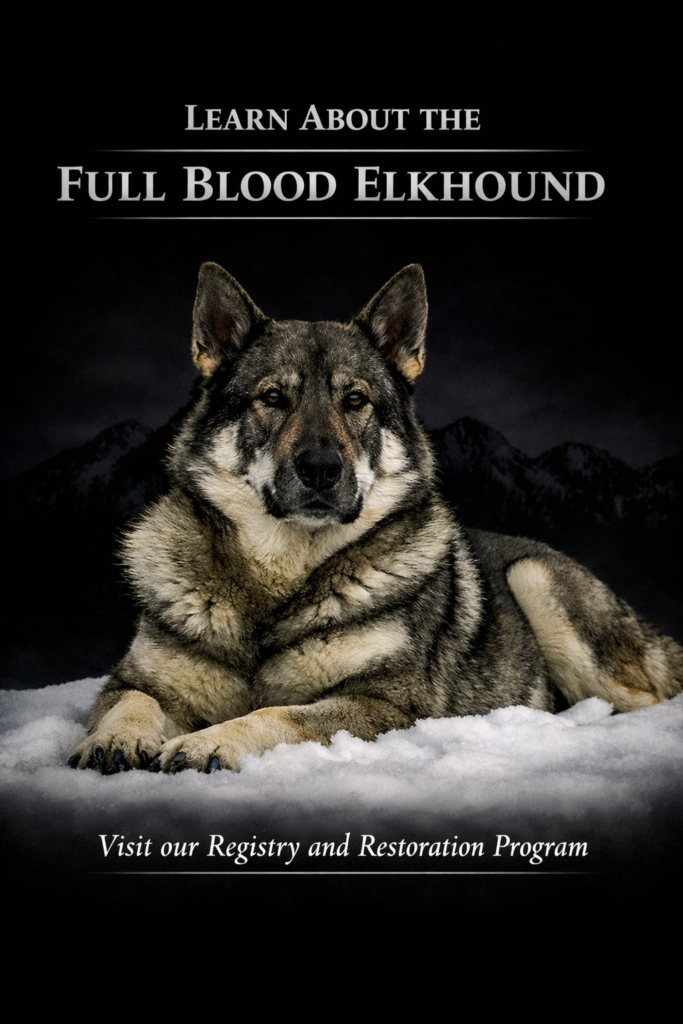
Now take Moki — a modern Kamia male.
Place him in that 1910 photo.
He fits perfectly. He is the same type, the same mass, the same silhouette, the same northern architecture.
He is the continuation of that lineage — the dog those old writers were describing.
Now take a 2026 AKC‑bred, show‑line “standard” male.
Drop him into that same photo.
He looks like a different species:
- lighter frame
- narrow chest
- weak legs
- shallow ribbing
- soft outline
- cosmetic coat
- no mass, no density, no working presence
He is out of place because he is out of place. He is the product of 70 years of cosmetic selection, not functional selection.


Why the Old Writers Chose Their Words Carefully
The men who wrote those early descriptions were not theorizing. They were not writing for judges. They were not trying to create a “breed standard.”
They were documenting the dogs that kept them alive.
When they said:
- robust
- powerful
- strong
- able to work all day
they meant exactly what those words mean.
They were describing dogs that:
- broke trail in deep snow
- tracked wounded game for miles
- held moose at bay
- survived northern winters
- worked in teams
- traveled with hunters for days
A 50‑pound cosmetic male cannot do that work. A 65‑pound northern powerhouse can.
The difference is not subtle. It is functional biology.
Bone density, muscle mass, lung capacity, rib depth, and stamina are not “opinions.” They are measurable, heritable, and essential to the original purpose of the Elkhound.


Why Modern Commentators Rewrite History
The reason is simple:
They no longer have the dogs the old writers described.
So they rewrite the meaning of the old words to fit the modern dog.
They cannot produce:
- big dark males
- 65‑lb working frames
- deep chests
- heavy bone
- northern stamina
- functional temperament
So they redefine “robust” to mean “compact.” They redefine “powerful” to mean “quick.” They redefine “working dog” to mean “active pet.” They redefine “endurance” to mean “likes to go for walks.”
It is linguistic sleight of hand — a way to protect the illusion that the modern show-line dog is still the same animal.
It isn’t.

Moki as the Modern Proof
Moki stands as a living contradiction to the revisionist narrative.
He is:
- big
- dark
- powerful
- deep‑chested
- heavy‑boned
- endurance‑built
- temperamentally stable
- structurally northern
He is the dog the old writers were describing.
He is the dog the modern ring cannot produce.
He is the dog that fits seamlessly into the 1910 photographs — because he is the continuation of that lineage, not a cosmetic reinterpretation of it.
Conclusion: The Words Still Mean What They Meant
The old writers were not vague. They were not confused. They were not describing small, light, quick little dogs.
They were describing the northern working Elkhound — the dog that built the reputation of the breed.
The modern show-line dog is not that dog.
The Full Blood Elkhound — and males like Moki — are.
Jaegar is the father of Moki!